

Products for Sale
We are currently taking orders for 100% pastured Galloway Beef
Katahdin lamb and young Boer goat, prices are listed below.
100 % grass-fed Galloway Beef
Our herd of heritage breed, Galloway cattle produce superior beef on pasture forage. Low in fat, tender and full of flavor, it is the ultimate in grass fed beef. The USDA Cycle IV Germ Plasm Evaluation Program at the Meat Animal Research Center (MARC) showed that Galloways placed at the top of the chart for flavor, juiciness and tenderness when compared to eleven other breeds. Commercial producers, feeders and packers note how the Galloway breed “fattens from the inside out,” depositing desirable marbling – taste fat – in their ribeyes long before they reach undesirable levels of cover, or waste fat – a rare, and highly sought-after characteristic. Galloway carcasses are well-marbled with large ribeyes. It is often said that Galloway beef has a distinctive eating quality, superior to other breeds.
The analytical marbling data and sensory data, shown below, affirm yet again that Galloway beef provides an excellent dining experience.
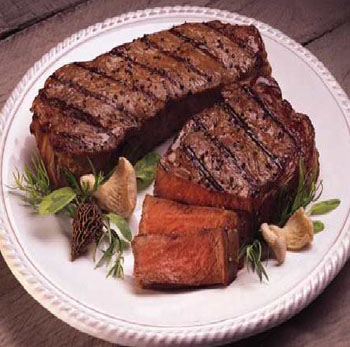 At the U.S. Meat Animal Research Center, sensory evaluation panels ranked Galloway beef head and shoulders above the 11 other breeds analyzed. In direct comparisons, Galloway ranked….1st in flavor, 2nd in tenderness and 2nd in juiciness.
Consumer Studies in Europe have shown the Galloway to be possessed of a unique marbling pattern comprised of very fine, discrete parcels of intramuscular fat distributed in a very even pattern. This is in contrast to larger, visible streaking deposits of fat common in many breeds.
Studies in Europe have shown the Galloway to be possessed of a unique marbling pattern comprised of very fine, discrete parcels of intramuscular fat distributed in a very even pattern. This is in contrast to larger, visible streaking deposits of fat common in many breeds. (Courtesy of the Galloway Breeders Association)
BUY GLEN EYRIE FARM GRASS FED BEEF BY THE HALF SIDE OR WHOLE or Variety Pack
Heritage Galloway Beef whole $3.90 Per Pound and half $4.25 Per Pound. Based on Pre-cut hanging weight.
Our Galloway steers are usually ready for processing at 1,000 to 1,100 pounds. An 1,100 pound steer results in an approximate pre-cut hanging weight of 650 pounds. 50% of 650 pounds would be about 325 pounds pre-cut hanging weight. This will yield between 200-220 pounds of packaged cuts per beef half.
Our local custom/USDA processor- Fauquier’s Finest Meats- will custom cut, wrap and flash freeze your balanced quarter beef share to your specifications. They have several excellent packaging and cuts options for you to choose from. You pick your options, and pay Fauquier’s Finest Meats directly for the processing of your beef share.
Visit Fauquiersfinest.com to see the great options available for your beef!
Fauquier’s Finest Meats indicated that a typical half would include approximately:
8 New York Strips
8 Tenderloin Filets
8 Sirloin Steaks
8 Round Steaks or 6 Roasts
2 Rump Roast
2 Sirloin Tip Roast or Steak
10 Chuck Roasts
8 Ribeye Steaks or 2 Standing Rib Roast
Short Ribs/Burger
Burger
Stew Meat
Soup Bones, Heart, Liver and Tongue if requested.
There is a $300.00 down payment required to reserve your half/whole beef. The balance is due at time of pick up at Fauquier’s Finest Meats. We will communicate with each customer and let you know when the dry aging and cutting are done, and then you may call Fauquier Finest Meats to arrange a pick up time.
Grass Fed VarietyPack (approx. 22 lb) $210
– 4 Steaks, 2/pkg. (combination of two packages of either New York Strip, Tenderloin, Rib-Eye, Sirloin Total approx. 3.5 to 4 lb)
– 1 Rump or Sirloin Tip Roast, approx. 3 lb
– 2 Round Steaks or additional 2-3 lb roast
– 2 Boneless Brisket or Chuck roast
– 12 lb. Lean Hamburger (ground beef) in 1 lb pkgs.
Hamburger Pack (approx. 10 lb) $65.00
– 10 lb. Lean Hamburger (ground beef) in 1 lb. pkgs.
Our beef is custom-aged for maximum tenderness and flavor. It is then cut, placed in vacuum-sealed bags.
100 % Grass-fed Katahdin Lamb
Katahdins are hardy, adaptable, low maintenance sheep that produce superior lamb crops and lean, meaty carcasses. They do not produce a fleece and therefore do not require shearing. They are medium sized and efficient, bred for utility and for production in a variety of management systems. Ewes have exceptional mothering ability and lamb easily; lambs are born vigorous and alert. The breed is ideal for pasture lambing and grass/forage-based management systems.
Adaptability: Katahdins have demonstrated wide adaptability. They were derived from breeds that originated in the Caribbean and British Islands, and the state of Maine was their original home. In cold weather, they grow a very thick winter coat which then sheds during warm seasons. Their smooth hair coat and other adaptive characteristics allow them to tolerate heat and humidity well. Katahdins are also significantly more tolerant of internal and external parasites than wooled sheep, and if managed carefully require only minimal parasite treatment.
 Temperament: Katahdins are docile so are easily handled. They exhibit moderate flocking instinct.
Size: Live weight of a mature ewe in good condition usually ranges from 125 to 185 pounds; a mature ram will weigh 180 to 250 pounds. Average birth weight of twins is about 8 pounds.
Reproduction: Ewes and rams exhibit early puberty and generally have a long productive life. Mature ewes usually have twins, occasionally producing triplets or quadruplets. A well-managed and selected flock should produce a 200% lamb crop. Rams are aggressive breeders, generally fertile year round, and can settle a large number of ewes in the first cycle of exposure. With selection a flock can consistently lamb throughout the year.
Mothering: The Katahdin ewe shows a strong, protective mothering instinct, usually lambs without assistance, and has ample milk for her lambs. Rejection of lambs is rare.
Carcass and Growth: Lambs produce a high quality, well-muscled carcass that is naturally lean and consistently offers a very mild flavor. Lambs are comparable to other medium-sized maternal breeds in growth and cutability. Lambs are desirable for specialty markets at a variety of ages and weights; wethers are appropriate for conventional North American markets at 95 to 115 pounds.
Coat: The hair coat of the Katahdin varies in length and texture among individuals and can be any color or color combination. It generally consists of coarse outer hair fibers and an undercoat of fine wooly fibers that becomes very thick and longer if cold weather sets in and day length decreases. This undercoat and some hair naturally sheds as temperature and day length increase seasonally, leaving a shorter, smooth summer coat. While some uses may be found for the shed fiber, it is generally not harvested.
Crossbreeding: The Katahdin can be used in crossbreeding programs. When crossed with wool sheep, the first generation offspring will in most cases have wool fleeces with hair interspersed (the wool from such crosses should be segregated to avoid contaminating higher quality wools). It usually takes at least 3 generations, depending on the type of wool sheep parentage, to obtain offspring with a shedding hair coat and other purebred characteristics. Katahdin ewes are well-suited as a base in a terminal sire crossbreeding program to produce market lambs.
Market: Katahdins are in demand by:
• those who want to raise sheep that do not need shearing
• producers who live in areas where wool is a detriment to adaptation or where wool markets are poor
• those who wish to eat or market superior quality lamb with a mild flavor
• stock dog trainers
• land managers looking for a low-maintenance small ruminant ( Courtesy of the Katahdin Hair Sheep International Association)
BUY GLEN EYRIE FARM GRASS FED LAMB BY THE WHOLE
Glen Eyrie Lamb whole $6.99 per pound hanging carcass weight.
Our lambs are usually ready for processing at about 70-90 pounds. An 80 pound lamb results in an approximate pre-cut hanging weight of 40 pounds.
Our local custom/USDA processor- Fauquier’s Finest Meats- will custom cut, wrap and flash freeze your lamb to your specifications.
100 % Grass-fed Young Boer Goat
The first full-blood Boers were brought into the United States in 1993, the same year the American Boer Goat Association was formed. Since that time a tremend ous amount of interest in breeding Boer and Boer influence goats has exploded in the United States.
The Boer goat is commonly a goat with a white body and a red head. Docile, high fertility and a fast growth rate are some of the traits that set the Boer goat apart in the purebred and commercial segments of the American meat goat industry. Mature Does can weigh between 190- 230 lb and mature Boer bucks can weigh between 200 – 340 lb.
The demand for high quality, lean, healthy red meat is the one of the underlining forces behind the development of the American meat goat industry. With an eager base of ethnic consumers, the demand for goat meat continues to grow in the United States each year. The importation of goat meat into the United States is estimated over 30 million dollars annually. (Courtesy of the American Boer Goat Association)
Check out this website http://modernfarmer.com/2013/09/goat-left-behind/, an interesting article about getting Americans to eat more goat meat and the wonderful health value in eating goat meat.